
The popular advice is to compare price per acre and grab the cheapest 5-acre parcel you can find. That shortcut fails often. Five acres with legal road access, suitable soils, nearby utilities, and workable zoning can be worth far more than a cheaper tract that needs an easement, a long driveway, a well, a septic solution, and an expensive path through local approvals.
A listing tells you what the seller wants. It doesn't tell you whether you can build, finance, insure, resell, or use the property for your intended purpose. Treat “5 acre land for sale” as a search category, not a value judgment. The right purchase is the parcel that works after due diligence, not the one that looks cheapest on a map.
Why Price Per Acre Tells You Almost Nothing
The cheapest five-acre listing can become the most expensive purchase after feasibility work. Five acres may include steep slopes, wetlands, flood exposure, poor soils, restrictive setbacks, or no practical access to a building site. Another parcel with the same acreage may border a maintained road, have utilities nearby, and support the intended residential use with fewer unknowns.
USDA figures provide a national reference, not a value for a specific listing. In 2024, average U.S. farm real estate value reached $4,170 per acre, while cropland averaged $5,570 per acre and pastureland averaged $1,830 per acre, according to the USDA land values report. Those figures produce rough five-acre references of $20,850 for average farm real estate, $27,850 for cropland, or $9,150 for pastureland, before local adjustments.
Location and intended use can change the result completely. Cropland values ranged from $1,280 per acre in Montana to $17,330 per acre in California in 2024. A five-acre parcel near a growing town may command a different price from a remote recreational tract, even when both contain the same acreage. Agricultural benchmarks do not account for buildable area, legal access, utility distance, or local demand for homesites.

Compare the usable outcome, not the listing headline
Consider two hypothetical listings. Parcel A is inexpensive but has no confirmed septic area, an uncertain road easement, and power far from the property. Parcel B costs more, yet has recorded access, a level homesite, nearby electrical service, and zoning that permits the buyer's intended residence.
Parcel A may look better in search results. Parcel B may be the sounder purchase because the buyer can establish feasibility sooner and estimate the total project cost with fewer assumptions. Hidden costs include failed soil testing, a redesigned driveway, extended utility runs, months of delay, or financing trouble caused by unclear access.
Practical rule: Price the parcel and the path to using it. If you cannot describe that path in writing, you do not know the property's real cost.
Historical figures add context but do not replace local comparable sales. USDA reported average U.S. farm real estate values of $4,080 per acre in 2023, $4,170 in 2024, and $4,350 in 2025, with cropland reaching $5,830 per acre in 2025 and pastureland reaching $1,920 per acre. The USDA historical land values publication shows upward movement in broad agricultural benchmarks, but those figures still cannot establish what a particular buildable homesite is worth.
Inspecting the Land Before You Commit
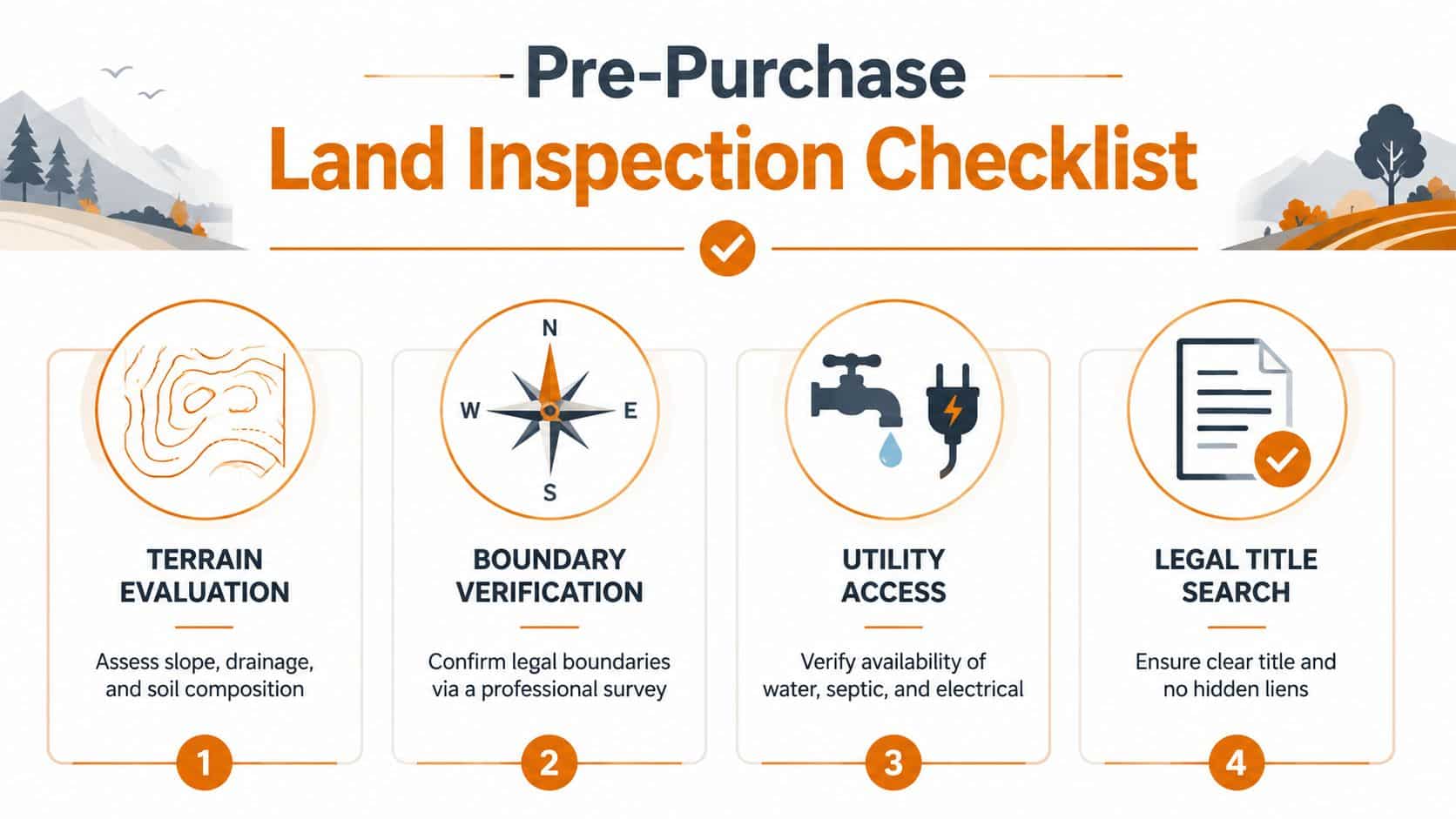
A five-acre parcel deserves a physical and legal inspection before you become emotionally committed. Start with the county parcel map, recorded deed, survey history, road records, zoning map, flood maps, and utility information. Online mapping is useful for screening, but it can't prove that a driveway is legal or that a building site will pass local requirements.
Use the county assessor's records to locate the parcel identification number. If the address is confusing or the listing uses a nearby road reference, this guide to finding a parcel number for an address can help you identify the correct public record before ordering documents.
Walk the ground with a purpose
Visit after rain if possible. Look for standing water, drainage channels, erosion, soft soil, retaining-wall needs, and the route a driveway would take. A five-acre parcel can contain several different conditions, so don't inspect only the area beside the road.
Arrange the right professional checks:
- Survey boundaries: A licensed surveyor should confirm corners, encroachments, frontage, and any mismatch between the deed and the listing map.
- Soil and septic feasibility: A qualified soil evaluator or local health department should explain whether the intended septic system can be approved and where reserve areas may be required.
- Flood and wetland review: Check official overlays, then ask a qualified environmental professional whether mapped constraints affect the proposed homesite.
- Access and title: A real estate attorney or title company should verify recorded access, easements, liens, restrictions, and the legal description.
- Utilities: Ask each provider for a written service assessment. “Power at the road” doesn't establish the cost of bringing service to a house site.
Visible access isn't legal access. A dirt track can cross a neighbor's property without granting you a recorded right to use it. Read the deed, title commitment, plats, and easement language. Confirm who maintains the road, whether the easement reaches the entire parcel, and whether its terms permit residential construction, utility installation, and emergency access.
Treat unanswered feasibility questions as contingencies
Don't rely on a casual seller statement that the land has “good water” or “will perc.” Ask for reports, permits, well records, utility letters, and recorded documents. If those materials don't exist, make the purchase agreement contingent on obtaining acceptable results during due diligence.
The goal isn't to eliminate every uncertainty. Rural land always carries unknowns. The goal is to identify which uncertainties could prevent your intended use and give yourself a contractual right to cancel or renegotiate before closing.
Navigating Zoning Rules and Financing Options
Zoning determines what you may do with the land, while financing determines whether you can complete the purchase without creating a cash-flow problem. Buyers often check one and assume the other will work out. That approach is risky, especially when a listing describes a parcel as suitable for a home, farm, cabin, or subdivision without showing the governing approval.
Agricultural zoning may support farming, livestock, accessory structures, or a residence, but the details vary by county. Residential zoning may allow a home but impose setbacks, road standards, minimum lot dimensions, or limits on accessory uses. Mixed-use districts can combine permitted uses with conditions, while conservation classifications may restrict clearing, grading, building areas, or vegetation removal.
Ask the planning office questions the listing can't answer
Take the parcel number and legal description to the county planning or zoning office. Ask for the written code section, not just a verbal summary. Confirm:
- Permitted use: Is the intended home, cabin, manufactured dwelling, farm activity, storage building, or short-term rental allowed?
- Dimensional rules: What setbacks, height limits, frontage rules, and minimum buildable-area requirements apply?
- Infrastructure standards: Must the road, driveway, fire access, water source, or septic system meet specific standards before approval?
- Environmental limits: Are floodplain, wetlands, steep-slope, habitat, or watershed rules triggered?
- Future flexibility: Would an accessory dwelling, subdivision, or commercial use require a variance, conditional use permit, or rezoning?
A variance usually addresses a specific hardship or dimensional rule. Rezoning changes the land-use classification and may require public notice, hearings, studies, and political support. Neither should be treated as a routine closing condition. If your purchase depends on an approval, make that approval an explicit contingency and confirm the timeline with local officials.
Match the loan to the actual asset
Traditional home mortgages generally underwrite a completed dwelling, not vacant land. A land loan, construction loan, seller-financed contract, or cash purchase may fit better, but each structure changes the buyer's risk.
Lenders may care about access, zoning, appraisal support, down payment, term, title quality, and the borrower's plan for the property. A lender's prequalification doesn't prove that this specific parcel is financeable. Give the lender the listing, survey, title information, zoning details, and intended use early.
Seller financing can make sense when the seller wants predictable payments and the buyer has a clear repayment plan. Read the note, deed arrangement, default terms, insurance obligations, taxes, prepayment rules, and release conditions with an attorney. Cash can simplify execution, but it shouldn't shorten due diligence. A fast closing on unusable land is still a bad purchase.
Estimating the True Cost of Ownership
The asking price is only the entry point. A usable budget separates acquisition costs, holding costs, and use-related costs before you make an offer. This prevents a recreational parcel from being judged against a homesite solely by price per acre.
Acquisition costs may include title work, title insurance, a survey, recording charges, legal review, and lender fees. Holding costs can include property taxes, insurance, road or association dues, vegetation management, security, and travel for periodic inspections. Use-related costs depend on your plan to build, farm, camp, hunt, store equipment, or leave the land vacant.
A low purchase price can become expensive if access, drainage, or a building site requires work.
Build a scenario budget
The table is a planning framework, not a quote. Local providers, site conditions, permits, construction choices, and contract terms will determine the actual cost. Avoid relying on unsupported dollar estimates until those factors are verified.
| Cost Category | Rural Recreational | Suburban Homesite | Agricultural Tract |
|---|---|---|---|
| Purchase price | Usually driven by remoteness, access, scenery, and recreation potential | Often reflects proximity to jobs, services, roads, and development demand | Influenced by soil quality, water, productivity, and permitted agricultural use |
| Due diligence | Title review, boundary confirmation, access verification, flood and environmental screening | Survey, zoning confirmation, soils, septic feasibility, utility verification, and site planning | Soil, water, access, conservation restrictions, agricultural use rules, and title review |
| Site work | May include gates, trails, clearing, drainage, or a basic access road | May include driveway construction, grading, drainage, utility trenches, and building-pad work | May include fencing, water systems, access improvements, clearing, or erosion control |
| Utilities | Often unavailable or distant, with buyers relying on private systems | More likely to be nearby, but connection and extension requirements still need confirmation | May require private water, septic, power extension, or off-grid systems |
| Ongoing ownership | Taxes, insurance, road maintenance, vegetation control, and security | Taxes, insurance, lawn or site maintenance, association dues, and construction-related carrying costs | Taxes, insurance, fencing upkeep, equipment access, and land management |
| First-year planning focus | Protect access and confirm whether the intended recreational use is legal | Prove buildability before spending on design or construction | Confirm productive use, water availability, and applicable agricultural rules |
Regional pricing varies widely, so broad market figures cannot establish a parcel's feasibility. The 2026 land pricing report describes general land-market conditions, but those figures do not account for a particular tract's road access, utilities, soils, restrictions, or usable area.
A remote bargain may require a private road, off-grid utilities, or repeated trips for maintenance. A costlier parcel near established services may have a lower path-to-use cost. Compare both purchase price and the work required to make the land serve its intended purpose.
Listings such as cheap land for sale in Maine can help you study asking prices and regional patterns. Treat every listing as a starting point. Confirm title, legal access, permitted use, site conditions, and ongoing obligations before calling the price a bargain.
Negotiating With Confidence Using Comparable Sales
A credible offer starts with closed sales, not the seller's optimism or a portal's price-per-acre filter. Appraisal guidance recommends identifying recent sales of similar vacant parcels, converting them to a consistent unit such as price per acre, and adjusting for meaningful differences. For a five-acre purchase, the strongest differences usually involve access, buildable area, utilities, terrain, zoning, water, and restrictions.
Build a small, disciplined comp set
Independent valuation guidance recommends using three to five strong comparable sales, with preference for recent transactions and similar acreage. The Iowa land valuation manual also describes the importance of normalizing sales and applying adjustments for site influences.
Don't collect every nearby listing. Choose the closest matches you can find, then explain why each one is stronger or weaker than the subject parcel. A larger tract may sell at a different unit rate. A parcel with a completed driveway or approved septic site isn't equivalent to raw land. An asking price can indicate competition, but it isn't closed-sale evidence.
Adjust the comp, then state your reasoning
Create a simple worksheet with the sale date, acreage, location, access, zoning, utilities, terrain, improvements, and sale price. Calculate the unit rate consistently. Then adjust the comparable for differences instead of pretending every parcel is interchangeable.
Useful negotiation evidence includes:
- Access defects: A missing recorded easement or uncertain maintenance obligation can justify a lower offer or a contract contingency.
- Utility uncertainty: Distant power, no public water, or unresolved septic feasibility affects both cost and timing.
- Physical limitations: Flood exposure, steep slopes, poor drainage, or limited building area reduce practical utility.
- Market positioning: Long marketing time, repeated price changes, or weak buyer interest may support a patient offer, but don't treat those signals as proof of value.
- Seller terms: A flexible closing date or acceptance of a feasibility contingency may be worth more than a small price concession.
A clear offer explanation sounds like this: “We reviewed the recent closed sales that most closely match the acreage and location. After adjusting for the subject property's access and utility uncertainty, our offer is based on the adjusted range. We'll keep the offer active if the title, access, zoning, and site checks meet the stated conditions.”
A rural-land brokerage reported 257 closed sales totaling about $484.8 million across 11 states since 2022, with a median sale-to-list ratio of approximately 95.5%, in its closed-sale evidence report. That evidence suggests correctly positioned properties can close near list, but it also shows why buyers shouldn't assume the asking price is automatically justified. The same report warns against using subdivision residual assumptions without entitlement. Future lot proceeds must account for development, financing, and marketing costs, so speculative upside isn't a substitute for present feasibility.
Your Pre-Offer Decision Checklist
Before submitting an offer on any 5-acre land for sale, work through the property in this order:
- Identify the exact parcel. Match the listing, address, parcel number, legal description, tax record, and map.
- Prove legal access. Confirm recorded rights, road maintenance, emergency access, and utility easements.
- Confirm the intended use. Ask the planning office for written zoning rules, setbacks, minimum standards, and approval requirements.
- Test buildability. Investigate slope, drainage, floodplain, wetlands, soils, septic suitability, water, and utility extension.
- Price the all-in plan. Add acquisition, site work, utilities, permits, taxes, insurance, maintenance, and financing costs.
- Use closed comparables. Build a local set of three to five strong sales, normalize the unit rate, and adjust for differences using the land-buying process.
- Write protective contingencies. Make title, access, zoning, feasibility, survey, and financing conditions specific and time-limited.
- Define your walk-away point. Stop if title defects remain unresolved, access depends on an unrecorded promise, or environmental restrictions block the intended use.
The best offer isn't necessarily the lowest one. It's the offer that reflects verified conditions and protects you from paying for potential the property can't deliver.
If you're evaluating land you already own rather than buying, Swift Land Buyers offers cash purchases for vacant land and lots, including as-is parcels, with due diligence and closing coordinated through title companies and escrow. Visit Swift Land Buyers to request an offer and discuss a practical sale path for a rural or vacant parcel.