

You've found a rural parcel online. The photos show open space, the price looks manageable, and the listing says “great development potential.” You're already thinking about a homesite, cabin, or future resale. Then the county map raises an access question, the seller can't produce a septic record, and the “road” ends at a locked gate.
That's where the procedure for buying land begins. A signed contract and recorded deed matter, but they don't prove the parcel is usable for your plan. The serious checkpoints are legal access, title, boundaries, zoning, utilities, environmental constraints, and registry-grade documentation. Skip one, and you can own land that can't support the project you bought it for.
What the Land Buying Process Actually Looks Like
A rural land purchase usually starts with a listing, not a courthouse. You find a parcel on a marketplace, contact the agent or owner, compare nearby sales, and submit a written offer. The offer should identify the parcel precisely and include the price, deposit terms, inspection period, closing target, title requirements, and the conditions that let you cancel if diligence exposes a material problem.
The first surprise often arrives after acceptance. The satellite image shows a dirt track, but the title report reveals that the track crosses another owner's property without a recorded easement. Or the seller says the lot is ready for a home, but the county has no current percolation test and the soil may not support a septic system. A zoning designation that sounds residential may still impose setbacks, frontage, floodplain, or minimum-lot requirements that make the building envelope too small.

The four phases that control the outcome
Pre-offer preparation comes first. Define the intended use, identify the parcel number, review public records, estimate improvement costs, and decide what evidence you need before your deposit becomes nonrefundable.
Due diligence is the risk screen. Order the title work, verify legal access, commission a survey where appropriate, check zoning and overlays, investigate utilities, and confirm soil, septic, flood, and wetlands conditions. Guidance for vacant-land closings recommends reviewing easements, encumbrances, liens, surveys, soils or septic designs, inspection reports, and the parcel immediately before closing. Nolo's vacant-land closing guidance explains why these checks belong before the final commitment.
Financing or cash preparation determines how much control you have over timing. A lender may require an appraisal, survey, environmental review, and additional underwriting. A cash transaction can remove lender conditions, but it still needs title clearance, escrow controls, and a recorded deed.
Closing coordination is handled through a title company, attorney, or escrow agent, depending on the jurisdiction. The professionals confirm the seller's authority, prepare settlement documents, collect funds, record the deed, and disburse money only after the agreed conditions are satisfied.
For a plain-language overview of the contract-to-closing sequence, review the Dollar Land Store buyer process. Use it as a process reference, not as a substitute for county-specific legal and planning checks.
Practical rule: Closing is not the finish line. Recording proves the transfer, but buildability determines whether the purchase was sound.
Preparing to Buy Land the Right Way
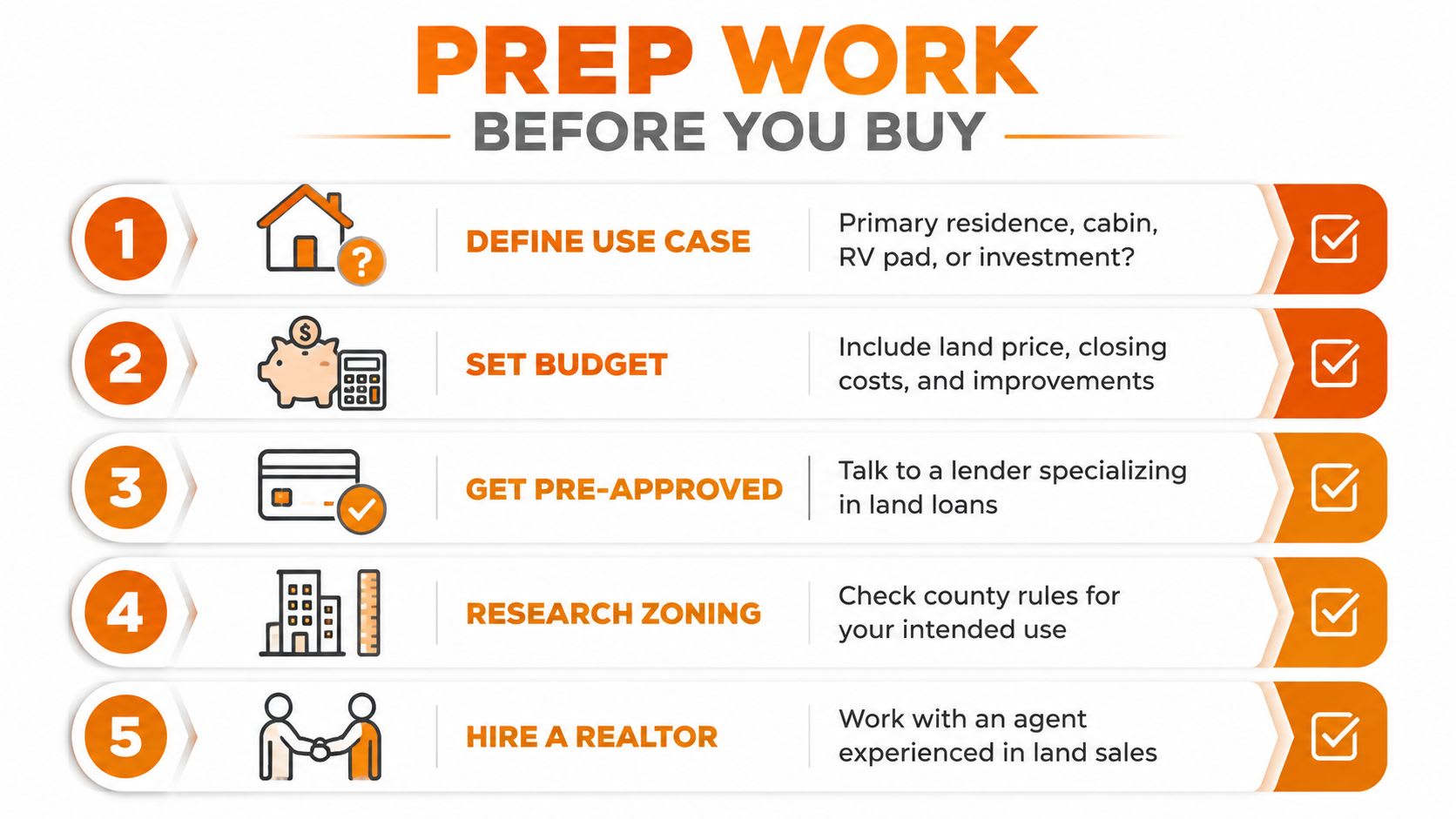
Start with the use case, not the listing. A parcel for a full-time residence has different requirements from land for a hunting cabin, recreational vehicle pad, agricultural use, or long-term investment. Write down the minimum road frontage, access type, acreage, slope, utility needs, and permitted structures before you compare properties.
Your budget must include more than the offer price. Reserve funds for closing expenses and leave room for surveys, soil work, driveway construction, utility extensions, clearing, drainage, and permit-related costs. Don't let a low purchase price distract you from a high improvement bill.
Assemble your buyer file
Have these items ready before making an offer:
- Identification: Keep a current government-issued ID available for the title company, lender, or closing attorney.
- Proof of funds: Cash buyers should be able to demonstrate available funds. Financed buyers should obtain a pre-approval from a lender that understands land loans.
- Income documentation: A lender may request tax returns, bank statements, employment records, and other underwriting documents.
- Parcel information: Collect the parcel identification number, legal description, county assessor record, tax status, and listing history.
- Written budget: Separate the acquisition price from diligence, closing, access, utility, and development reserves.
- Dedicated communication: Use a dedicated email folder for the offer, title commitment, survey, zoning responses, invoices, and closing notices.
A construction lender may evaluate the land and the planned improvements together, so buyers planning to build should understand the differences between a land loan and construction financing for real estate investors. Don't assume that approval for the parcel automatically covers the home, site work, or utility installation.
Here's the pre-offer checklist I'd want on paper:
- Define the intended use and minimum physical requirements.
- Confirm the parcel number and legal description match the listing.
- Review assessor, tax, zoning, flood, and road information.
- Decide which contingencies are essential.
- Confirm how the deposit will be held and when it becomes at risk.
- Identify the title company, attorney, surveyor, and planning office.
- Set a walk-away price that includes development uncertainty.
The preparation stage feels slow because it is supposed to prevent emotional buying. If you can't explain how the parcel will be accessed, permitted, serviced, and resold, you're not ready to make the offer.
Title, Surveys, and Access Verification
Treat title, survey, and access as one connected risk screen. A clean deed does not compensate for a boundary conflict, and a visible road does not create a legal right to use it. You need evidence that the seller owns the interest being conveyed, that the parcel's boundaries are defensible, and that you can legally reach and use the property.
The title company or closing attorney searches recorded instruments and prepares a title commitment or preliminary report. That review can identify liens, judgments, unpaid taxes, unreleased mortgages, probate problems, easements, restrictions, mineral-rights reservations, and recording errors. Ask the title professional to explain every exception. “Subject to standard exceptions” isn't a satisfactory answer if you don't know what those exceptions cover.
A survey adds the physical layer. It can show whether fences, drives, structures, streams, or neighboring improvements cross the boundary. For a more complex parcel, an ALTA survey may provide a broader review of title-related matters, but the right survey depends on the transaction, location, lender, and intended use.
Access requires ground-level proof
Legal access may come from a public road, a recorded ingress-and-egress easement, or a properly documented private drive. A track visible on a mapping application is only a physical clue. Read the recorded easement for its location, width, permitted users, maintenance obligations, and utility rights. An access easement that allows vehicles but not buried utilities can still prevent development.
Walk the route. Check gates, steep grades, washouts, locked barriers, culverts, and points where the route crosses another parcel. Ask the county whether the road is publicly maintained, but don't treat a verbal answer as a substitute for recorded documentation.
The question isn't whether you can reach the land today. It's whether you have an enforceable right to reach it tomorrow.
| Verification Step | Source or Provider | What It Confirms | Common Deal-Killer Caught |
|---|---|---|---|
| Title search | Title company, closing attorney, county recorder | Ownership, liens, judgments, easements, restrictions | Unreleased mortgage, heirship issue, tax lien |
| Survey | Licensed surveyor | Boundaries, monuments, encroachments, access alignment | Overlap, fence on the wrong line, missing corner |
| Access review | Recorded land records, county road office, site inspection | Legal ingress, egress, maintenance, utility rights | No legal access, blocked easement, unusable route |
| Title insurance commitment | Title insurer | Covered risks and exceptions to coverage | Restriction that could impair marketability |
| Parcel and record comparison | Assessor, recorder, planning office | Consistency between legal description, map, and public records | Deed error, split not reflected in records |
The failure points are well documented in land due diligence guidance. One industry guide reports that about one in four raw-land deals reveals a material issue during diligence, with examples including no legal access, wetlands occupying more than 30% of usable area, incompatible zoning, code-enforcement liens, contamination, encroachments, and conservation easements. Serious Land Capital's due-diligence guide also identifies agricultural title problems such as missing heirs, old mortgages, ambiguous easements, severed mineral rights, and deed errors.
For a clear explanation of parcel identifiers and why they matter in public records, use this guide to what a parcel is. The final file should connect every clearance statement to a recorded instrument, survey, official response, or title commitment exception.
Permits, Zoning, and Buildability Checks
A parcel can be transferable and still be unusable. Buildability is the point where the purchase plan meets the county's actual rules, soil conditions, environmental limits, and utility network.
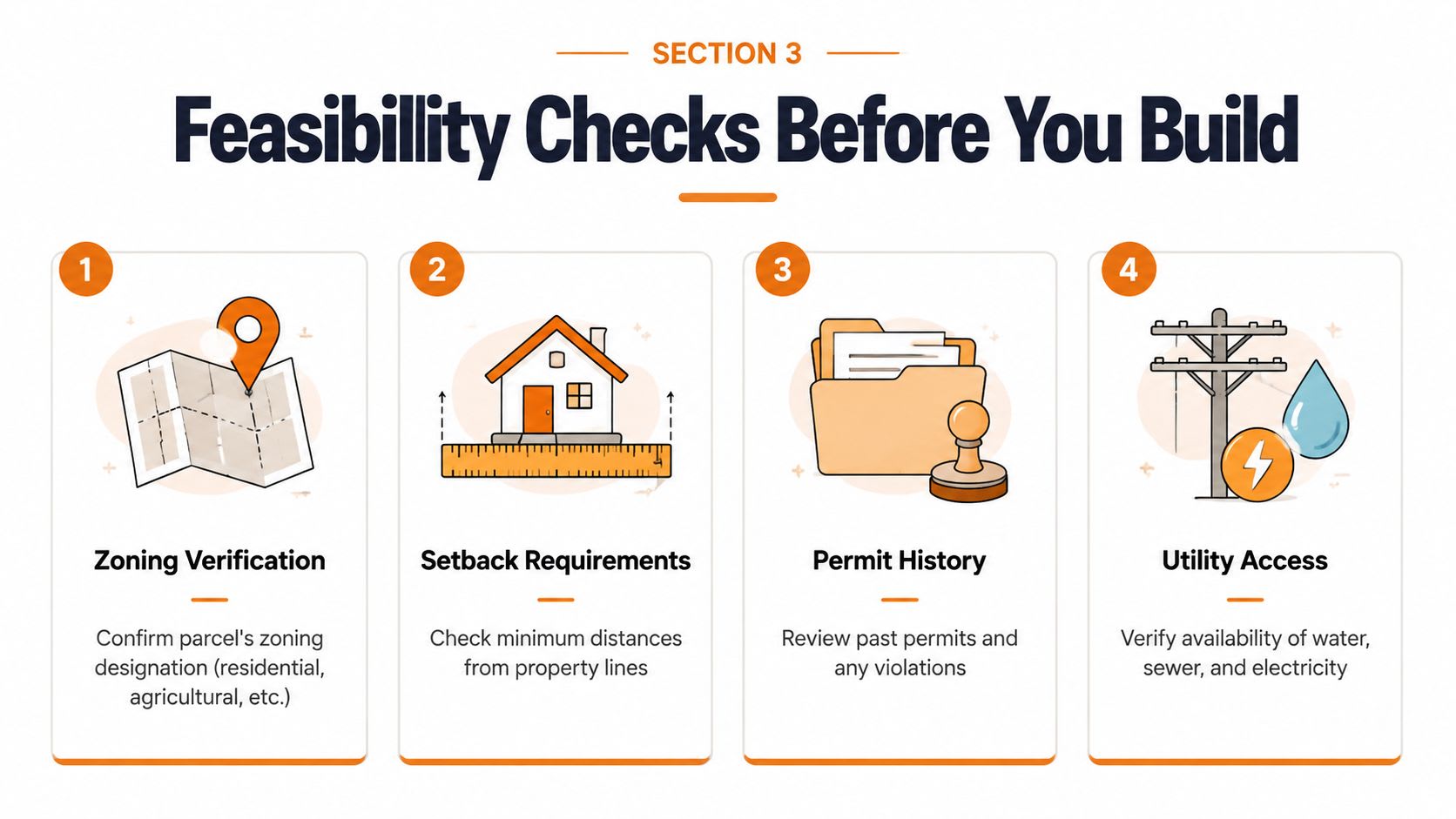
Call the planning or zoning office with the parcel number. Confirm the current zoning designation, permitted uses, conditional-use requirements, overlay districts, future-land-use map, minimum lot size, frontage, height limits, and setbacks. Ask whether the intended structure requires a variance or special approval. Request the answer in writing when possible.
Then draw the likely building envelope. Start with the property lines, subtract front, side, and rear setbacks, and remove areas affected by streams, steep slopes, flood hazards, wetlands, septic setbacks, access corridors, and utility easements. A large parcel can have a surprisingly small usable area.
Test the site, not the seller's description
If the property will need septic, contact the relevant health or environmental department about a soil evaluation or percolation test. Verify whether an existing test is current, tied to the exact parcel, and suitable for the intended system. An expired or incomplete test shouldn't be treated as proof of a buildable lot.
Check the permit history for abandoned applications, failed inspections, violations, and unresolved enforcement actions. Confirm the requirements for:
- Driveway access: Determine whether a driveway cut, culvert, sight-distance review, or road permit is required.
- Water and sewer: Ask whether public lines reach the parcel and what connection process applies.
- Private wells: Verify well permits, setbacks, groundwater restrictions, and testing requirements.
- Environmental review: Investigate wetlands, protected habitat, floodplain rules, and conservation restrictions.
- Private covenants: Read HOA or POA declarations, architectural rules, use limits, and road-maintenance terms.
Neutral buildability guidance highlights zoning, setbacks, overlays, FEMA flood zones, wetlands, access, utility proximity, and permit timelines as core diligence items. It also warns that utility extensions can cost roughly $15,000 to $50,000 when lines are a few hundred feet away, and that approval timelines can vary by more than 14 months between nearby cities with similar zoning. Buildability's land due-diligence guide provides the supporting context for those risks.
Allow a practical feasibility window of two to ten weeks for responses, site work, and document review. The exact schedule depends on the county and the complexity of the parcel, but you should never let a short inspection period force a blind decision.
Buildability is not a marketing adjective. It's a conclusion supported by zoning records, site testing, access documents, and utility answers.
Closing Through Title and Escrow
Once the purchase agreement is signed, the title company opens escrow and the buyer delivers the required deposit. The escrow officer coordinates the title search, payoff requests, deed preparation, tax information, survey documents, lender requirements, and closing instructions.
A financed transaction commonly moves through several overlapping workstreams. The lender reviews the borrower and property, the title company identifies defects, and the buyer investigates physical feasibility. A cash closing has fewer parties, but it still needs the same ownership and recording discipline.

What happens before signing
The title commitment arrives with requirements and exceptions. The seller must cure the issues that prevent conveyance, which may involve paying liens, obtaining releases, correcting a deed, resolving probate, or securing signatures from additional owners. The buyer should review the survey against the legal description and ask questions before approving the final package.
For financed buyers, the lender may require an appraisal, insurance documentation, and additional property or environmental materials. The lender also controls certain disclosure and timing requirements. Don't schedule movers, contractors, or site work until the title company confirms that funding and recording are on track.
A useful reference for the contract itself is this vacant land purchase agreement guide. The agreement should clearly state inspection rights, title standards, default remedies, closing costs, possession, prorations, and the treatment of surveys and easements.
Closing-day controls
Bring government-issued identification, proof of wire instructions verified by phone, a copy of the signed agreement, evidence of insurance if required, and any lender documents requested in advance. Never rely on an emailed last-minute change to wiring instructions. Call a known number for the title company and confirm the details verbally.
At signing, the buyer typically executes the settlement statement and related affidavits, while the seller signs the deed and transfer documents. The title company collects funds, confirms conditions, submits the deed for recording, and disburses money according to the settlement statement.
A financed purchase often takes 30 to 45 days, while a cash purchase often takes 10 to 21 days, depending on title condition, local recording practices, survey requirements, and the parties' responsiveness. Those ranges should guide planning, not replace a written closing schedule.
The legal transfer isn't complete merely because the parties signed. In England and Wales, HM Land Registry's Price Paid Data records sales submitted for registration and has been available as monthly open data since December 2011, creating a long-running public record connected to the formal purchase process. HM Land Registry's Price Paid Data illustrates the broader principle: registry entry creates the official audit trail used for title verification and transaction analysis.
Spain's official transfer statistics use land-registry information and count transfers recorded in the registries. In June 2026, the registry recorded 206,138 properties, up 7.0% year over year, while registered sales and purchases rose 1.6% from June 2025. Spain's official property-transfer statistics reinforce the same operational lesson: a private contract is not the same as a completed, registry-backed transfer.
Cash Buyers, Timelines, and Final Tips
Financing gives you purchasing power, but it adds lender conditions, appraisal risk, underwriting, and document dependencies. A cash buyer removes much of that machinery. The buyer still needs title work, escrow, and recording, but the transaction can move directly from offer to diligence to funding.
Cash buyers may also request fewer contingencies, offer as-is terms, and provide a seller-selected closing date when the title company can meet it. That speed has a tradeoff. A buyer who skips inspections or accepts weak evidence in exchange for speed may inherit the exact defect that diligence was meant to find.
| Step or Factor | Traditional Financed Purchase | Cash Buyer Purchase |
|---|---|---|
| Funding source | Land lender and borrower underwriting | Buyer's available funds |
| Appraisal | Often required by the lender | Usually not lender-driven |
| Contingencies | Financing, appraisal, title, and inspection conditions may apply | Title and agreed diligence conditions remain central |
| Timeline | Often longer because lender review adds dependencies | Often shorter when title is clean and documents are ready |
| Closing certainty | Can change if underwriting or valuation fails | Depends mainly on funds, title clearance, and buyer diligence |
| Property condition | Lender may request additional evidence | Buyer negotiates inspection and as-is terms directly |
| Recording | Deed records after signed documents and funding | Deed records after signed documents and funding |
A direct cash path such as Swift Land Buyers can shorten the transaction by using a phone consultation or form intake, a due-diligence period, and title-company closing. The company purchases vacant land and lots for cash, handles as-is acquisitions, and coordinates disbursement through escrow, but title clearance still controls the final date. Review the best way to buy land before choosing between a financed purchase, an open-market listing, or a direct offer.
Use this final checklist before you waive your protections:
- Walk the access route: Confirm the route on the ground, not just on a map.
- Verify utilities at the parcel: Ask the provider where service ends and what connection work is required.
- Read disclosures: Compare every seller statement with county, title, survey, and environmental records.
- Document easements: Save the recorded instruments and mark their locations on the survey.
- Protect the wire: Call the title company using a trusted number before sending funds.
- Review resale risk: Keep the survey, title policy, permits, zoning responses, and diligence file for the next buyer.
- Set a walk-away point: If access, septic, zoning, or title remains unresolved, stop negotiating rather than rationalizing the risk.
The best procedure for buying land isn't the fastest sequence of signatures. It's the process that proves you can own the parcel, reach it legally, use it lawfully, and explain its limitations to the next buyer.
If you're selling vacant land, inherited acreage, or a rural lot that needs an uncomplicated exit, Swift Land Buyers offers a direct cash-purchase process with title-company and escrow coordination. Submit the parcel details, review the offer, and use the diligence and closing steps above to decide whether the timeline fits your situation.