

You inherit a vacant parcel from a relative, but the property may be several states away, the deed may still show the deceased owner, and other heirs may disagree about whether to sell. Meanwhile, taxes, insurance, liens, and maintenance obligations keep moving. You don't need a generic tax tutorial. You need a plan that resolves authority, title, tax basis, valuation, and sale method in the right order.
Selling inherited land is both a real-estate transaction and a legal cleanup project. If you skip the legal work, a buyer may not be able to close. If you skip the valuation work, you may accept a low offer just because the property feels like a burden. The sections below show how to sell inherited land while protecting your timeline and your share of the proceeds.
The Reality of Selling Inherited Land in 2026
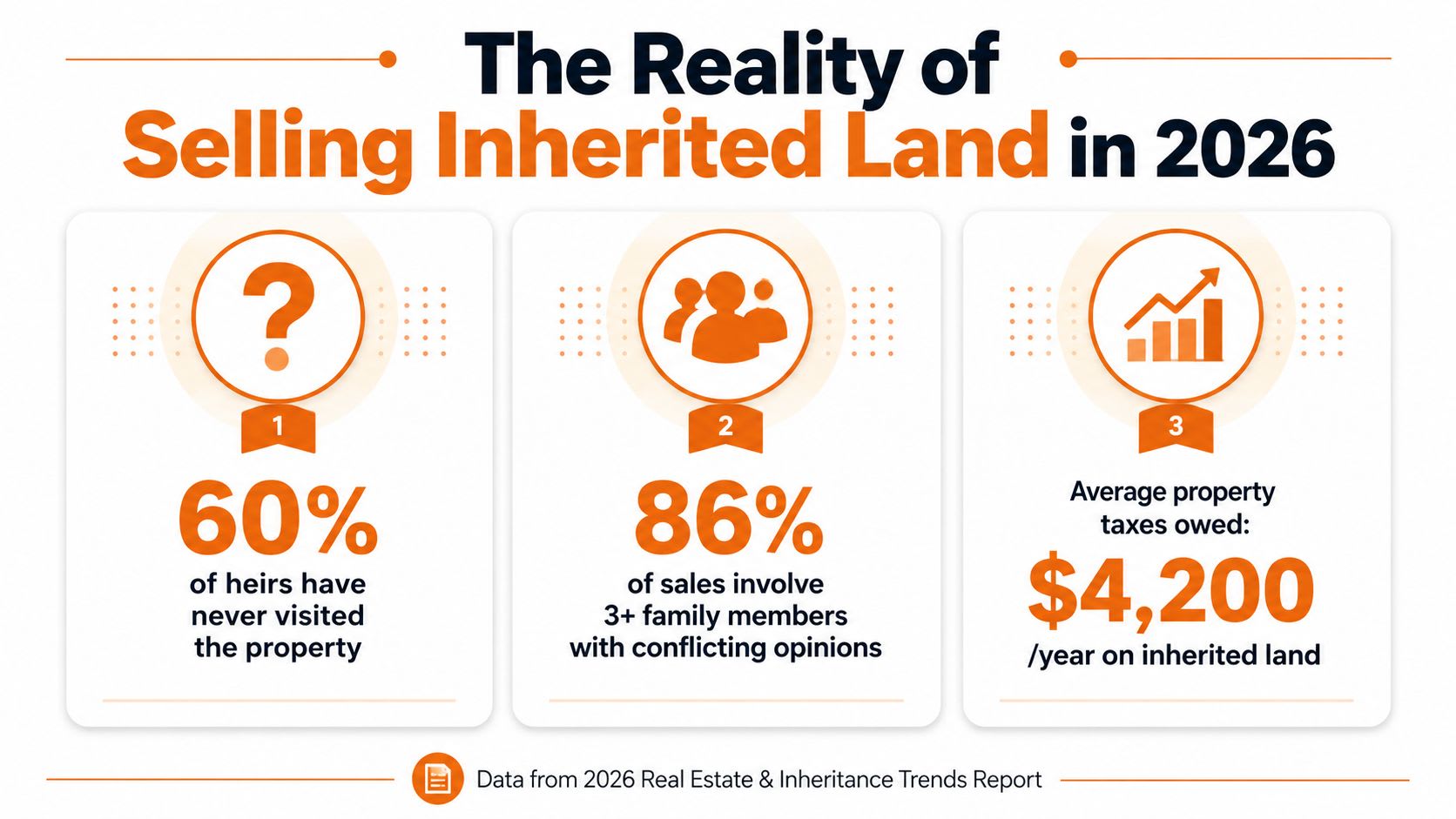
A typical inherited-land problem starts when a parent dies. The family discovers a rural lot or wooded acreage in the estate, and one heir volunteers to handle it. That heir may never have visited the property. A sibling wants cash immediately, another thinks the land should stay in the family, and nobody knows whether the will, deed, or probate file gives anyone authority to sell.
The first mistake is treating the parcel like ordinary property. You can't just find a buyer, sign a purchase agreement, and assume the closing agent will sort everything out. The sale depends on who legally owns the land, who has authority to sign, whether every required heir has been identified, whether taxes or liens are outstanding, and whether the title company can insure the transfer.
Four decisions control the outcome
You need to answer four questions before choosing a marketing strategy:
- Who can sign: Determine whether the land passes through probate, a trust, a transfer-on-death arrangement, or survivorship ownership.
- Is title clean: Confirm that the deed, probate records, heirship documents, easements, liens, and ownership interests line up.
- What is the tax basis: Establish the property's fair market value at the date of death so you can calculate any taxable gain correctly.
- Which sale path fits: Compare a direct cash sale, an MLS listing, and an auction based on speed, certainty, effort, and expected net proceeds.
The timeline can be short when the title is clean and authority is already established. It can stretch substantially when probate is unfinished, heirs are missing, or family members disagree. A 2026 survey of 1,350 heirs and executors found that completed inherited-property sales had a median time from death to closing of 11.4 months. The same survey reported that 45% of transferred properties went through probate, while 26% went through a living trust, 12% used a transfer-on-death or beneficiary deed, and 11% involved joint ownership with right of survivorship. See the survey's inherited-property closing timeline and ownership data.
Practical rule: Don't spend weeks advertising land before you know who has the legal right to sell it.
The process becomes manageable once you separate the emotional family decision from the transaction mechanics. Gather the estate documents first, establish authority, order title work, document the tax basis, and then choose the buyer channel that matches your priorities.
Probate, Trusts, and Other Ways to Get Authority to Sell
The person who wants to sell isn't always the person who can legally convey the land. A buyer and title company need evidence that the signer has authority, not merely a family agreement or an informal understanding.
Start by collecting three items: the death certificate, the will or trust document, and every prior deed you can find. Add any transfer-on-death deed, beneficiary deed, survivorship language, estate inventory, and existing probate paperwork. Those documents usually reveal which legal path applies.
Probate gives the representative formal authority
If the property was owned individually and the owner died with a will, the estate is generally testate. The nominated executor may still need to be appointed by the probate court before signing for the estate. If there was no will, the estate is intestate, and the court appoints an administrator under state law.
The personal representative gathers assets, handles debts, and may sell real estate when permitted by the will or court order. The title company will typically request court appointment documents, the will if applicable, proof that the appointment remains active, and a deed signed in the correct capacity. Some jurisdictions require court approval for a specific sale, so local counsel should confirm the procedure before you accept an offer.
A small-estate process may be available where state law permits it. It can reduce court administration, but it doesn't automatically eliminate title requirements. Ask the probate clerk or an estate attorney whether the parcel qualifies and whether the resulting affidavit or order will satisfy the title insurer.
Nonprobate transfers can bypass court administration
A properly funded living trust can transfer the land through the successor trustee rather than probate. The trustee will usually provide the trust certification, relevant trust provisions, death certificate, and a trustee's deed or other conveyance approved by the title company.
A transfer-on-death or beneficiary deed can pass the property directly to a named beneficiary after the owner's death, if the deed was validly executed and recorded under state law. The beneficiary may still need to record an affidavit, death certificate, or other documentation before selling.
With joint ownership and right of survivorship, the surviving owner may receive the deceased owner's interest automatically. That doesn't mean the record title is instantly ready for resale. The surviving owner generally must provide the death certificate and any affidavits or recorded documents required by the local recorder and title insurer.
Don't confuse an heir's beneficial interest with present signing authority. If the title company can't verify the transfer, the buyer can't obtain insurable title, even if every family member agrees in principle.
Tax Liability When Selling Inherited Land
You inherit a rural parcel, receive an offer, and assume the sale proceeds equal taxable profit. That assumption can create an unnecessary tax bill. The central rule is stepped-up basis. Under general U.S. tax rules, inherited property generally receives a basis reset to its fair market value on the decedent's date of death. An alternate valuation date may apply if the estate elected it. The IRS guidance on gifts and inheritances explains this general treatment.
Your taxable gain is generally measured against that new basis, not the deceased owner's original purchase price. Selling near the date-of-death value may leave little gain to report. Appreciation after death can create capital-gains exposure on the increase above the documented basis. Federal and state rules can differ, so have a CPA review the estate, the seller's residence, and the land's location before accepting an offer.
Document the new basis before marketing the parcel
A date-of-death appraisal provides the strongest practical evidence of the stepped-up basis. It should identify the parcel, valuation date, highest and best use, comparable sales, access, zoning, and other factors affecting value. Tax-assessed value offers useful background, but it often cannot replace a defensible market valuation.
Keep the appraisal with settlement documents, the closing statement, improvement records, and any estate tax filings. Without clear basis documentation, tax authorities may challenge the amount, forcing heirs to reconstruct value after closing. Review the applicable IRS guidance with a qualified tax professional. It provides general information, not individualized tax advice.
Estate administration also affects the sale itself. A University of Florida law review study found that 63% of intestate homes sold for at least 75% of fair market value, compared with 89% of testate homes. At the 90%-of-fair-market-value threshold, the comparison was 44% for intestate homes and 79% for testate homes. Reported median values were $69,333 for intestate homes sold at 90% or more of fair market value and $175,075 for comparable testate homes. These figures concern homes, not vacant land, but they show how unclear authority and estate administration can affect pricing and execution. The discussion and source context appear in guidance on inherited land, title, taxes, and heirs.
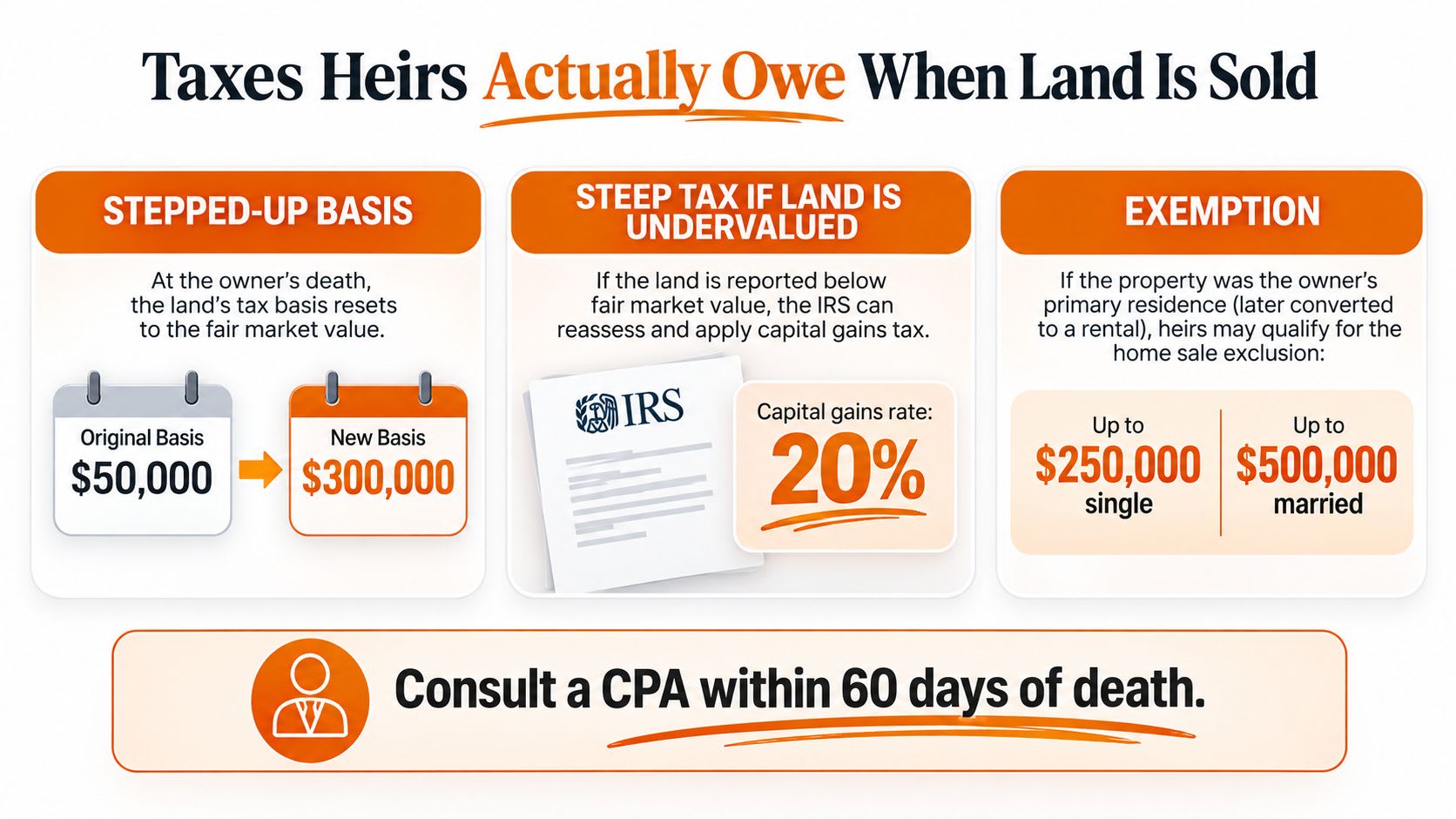
Do not let tax fear dictate the sale. Establish the basis, have a CPA estimate the likely gain, then compare that result with ongoing ownership costs and the realistic time required to sell. A fast cash offer may reduce holding costs, while an MLS or auction strategy may produce a different price and timeline. The right choice is the one that preserves value after taxes, carrying costs, and transaction delays.
Clearing Title, Heirs Property, and Family Disputes
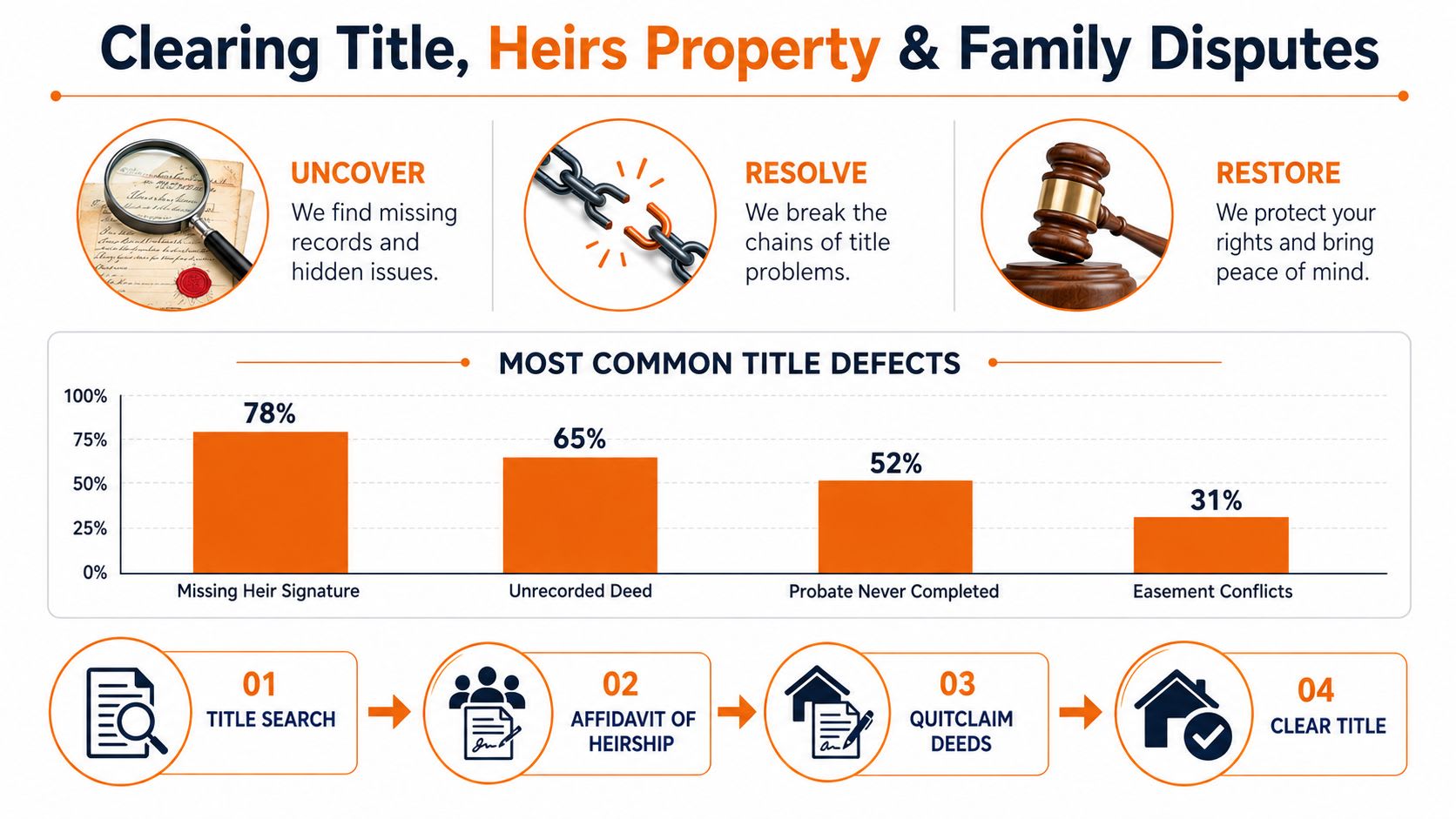
Title problems stop inherited-land sales more often than cosmetic property issues. A current title search or title commitment can reveal unreleased mortgages, tax liens, old deeds, incorrect legal descriptions, easements, probate gaps, unreconciled transfers, and co-owners who were never included in the proposed sale.
The most difficult category is heirs property. This occurs when multiple relatives inherit an interest, often without a clear recorded transfer, and each person may hold an undivided ownership interest. In 44 states plus D.C., researchers estimated 508,371 heirs' properties worth about US$32 billion, according to reporting on tangled titles and family homesteads. The issue isn't confined to large estates. A small rural parcel can become just as difficult to convey when ownership fragments across generations.
Find the defect before finding the buyer
Order a title commitment early. Then ask the title company to identify:
- Missing signatures: Locate every living owner, estate representative, spouse, or heir whose interest must be conveyed.
- Unrecorded transfers: Compare family records with county records and determine whether an earlier deed was never recorded.
- Unfinished probate: Check whether a prior owner died before the estate completed its transfer.
- Heirship uncertainty: Investigate unknown, deceased, adopted, or relocated heirs when the title history requires it.
- Land-use conflicts: Review access rights, boundary descriptions, easements, restrictions, and mineral or timber interests.
Some defects can be cured with recorded affidavits, corrective deeds, quitclaim deeds, or probate orders. A quitclaim deed may help transfer a known interest, but it doesn't independently prove that no other heir has a claim. A title company can identify the underwriting requirements, while a real-estate attorney should handle disputed ownership, quiet-title actions, contested probate, and partition risk.
Consider two siblings who inherit a rural lot. One wants to sell, the other refuses because of an old family disagreement. The willing sibling can't convey the entire parcel alone. A negotiated buyout may resolve the dispute if the parties agree on value and financing. If negotiation fails, a partition action may force a court-supervised resolution, but it can add cost, delay, and uncertainty.
The cheapest title cure is the one you identify before accepting an offer.
Use a title company for the commitment, escrow, recording coordination, and insurability analysis. Bring in an attorney when the parties disagree, a deceased owner remains on title, an heir can't be located, or the title insurer requires a court remedy.
Cash Buyer vs MLS vs Auction for Inherited Land
Once authority and title are addressed, you can choose how to sell. The right method depends on whether your priority is speed, maximum exposure, certainty, or minimal work. There isn't one universally correct channel, but there is a wrong channel for every situation.
| Factor | Cash Buyer | MLS Listing | Auction |
|---|---|---|---|
| Speed | Usually the fastest path when title is ready | Depends on pricing, buyer demand, and negotiations | Marketing period and auction scheduling control the timeline |
| Closing certainty | High when the buyer has cash and no financing contingency | Lower because the buyer may need financing, appraisal, or additional approvals | Depends on reserve terms, bidder quality, and closing conditions |
| Net proceeds | Offer may be below an optimistic retail estimate, but carrying costs and preparation can be lower | May produce a higher gross price, reduced by commissions, preparation, concessions, and holding costs | Can create competition, but fees and an uncertain final bid affect the net |
| Property condition | As-is sale is often possible | Access, cleanup, documentation, and market-ready presentation matter more | Broad appeal and credible marketing are important |
| Heir effort | Low, especially for out-of-state owners | Higher, with showings, questions, negotiation, and preparation | Moderate to high, because family must accept auction risk and coordinate terms |
When a cash buyer makes sense
Choose a direct cash buyer when the heirs value certainty and simplicity more than an uncertain retail upside. This works particularly well for remote rural land, parcels with difficult access, inherited lots that need cleanup, and families that don't want to coordinate surveys, showings, or improvements.
A cash offer still needs scrutiny. Request the purchase price, closing date, inspection or diligence rights, title requirements, cancellation rights, and allocation of closing costs in writing. Confirm that the buyer isn't relying on financing and ask whether the buyer will close directly or assign the contract.
When MLS deserves the lead
An MLS listing is usually the better route for a buildable, well-located lot with strong buyer appeal, clean title, usable access, and heirs willing to wait for market exposure. A land-focused agent can market zoning, utilities, road frontage, soil information, surveys, and development potential instead of posting a bare parcel description.
The higher headline offer isn't automatically the higher net. Deduct commissions, preparation expenses, buyer credits, carrying costs, and the value of the extra time before comparing it with a cash offer.
When an auction is appropriate
Auction can work when the property has broad appeal and the family wants a defined competitive process. It can also expose the parcel to buyers who actively monitor land auctions. The tradeoff is less control over the final price, especially if bidding is thin or the reserve isn't met.
My recommendation: Use cash for speed and certainty, MLS for a strong retail parcel with time, and auction only when the land and family can tolerate an unpredictable result.
Valuing the Land and Avoiding Lowball Offers
Online estimates are a starting point, not a valuation. Raw land doesn't behave like a standard house because buyers price uncertainty into access, utilities, zoning, topography, buildability, marketability, and title risk. A parcel that looks valuable on a map may be difficult to finance, subdivide, access, or develop.
Build your price opinion from recent comparable land sales in the same county or a similar market. Compare acreage, road frontage, legal access, utilities, zoning, flood exposure, slope, soil, timber, mineral rights, restrictions, and whether the comparable had clean title. Asking prices don't prove value. Closed sales are more useful.
A defensible pricing file
Create a short file that includes:
- Comparable sales: Record the sale date, location, acreage, price, access, and major differences.
- Property facts: Confirm the parcel number, legal description, zoning, utilities, road status, and any survey.
- Value constraints: List liens, easements, title defects, back taxes, restrictions, steep terrain, wetlands, or uncertain boundaries.
- Buyer assumptions: Ask what the buyer believes the land is worth and which costs the buyer expects to incur.
Buyers discount land for illiquidity and uncertainty. That doesn't make every discount fair. It means you need to separate a legitimate risk adjustment from a convenient excuse to underpay.
Negotiate from evidence
Don't accept an online estimate as your anchor, and don't let an emotional attachment set the price. Use comparable sales to establish a range, then ask each buyer to explain the assumptions behind the offer. If a buyer cites access problems, request the evidence. If the buyer cites development limits, verify the zoning and county requirements.
Never accept the first offer without considering a counter. You can counter on price, closing date, earnest money, title costs, diligence length, or the exact parcel being sold. If the buyer won't improve price, a more favorable closing date or cost allocation may still increase your net result.
A professional appraisal is especially useful when heirs need to divide proceeds fairly, the date-of-death basis needs support, or the parcel has unusual development potential. Pay for evidence when the property is valuable enough that an unsupported price could cost more than the appraisal.
From Offer to Funded Closing in as Little as 21 Days
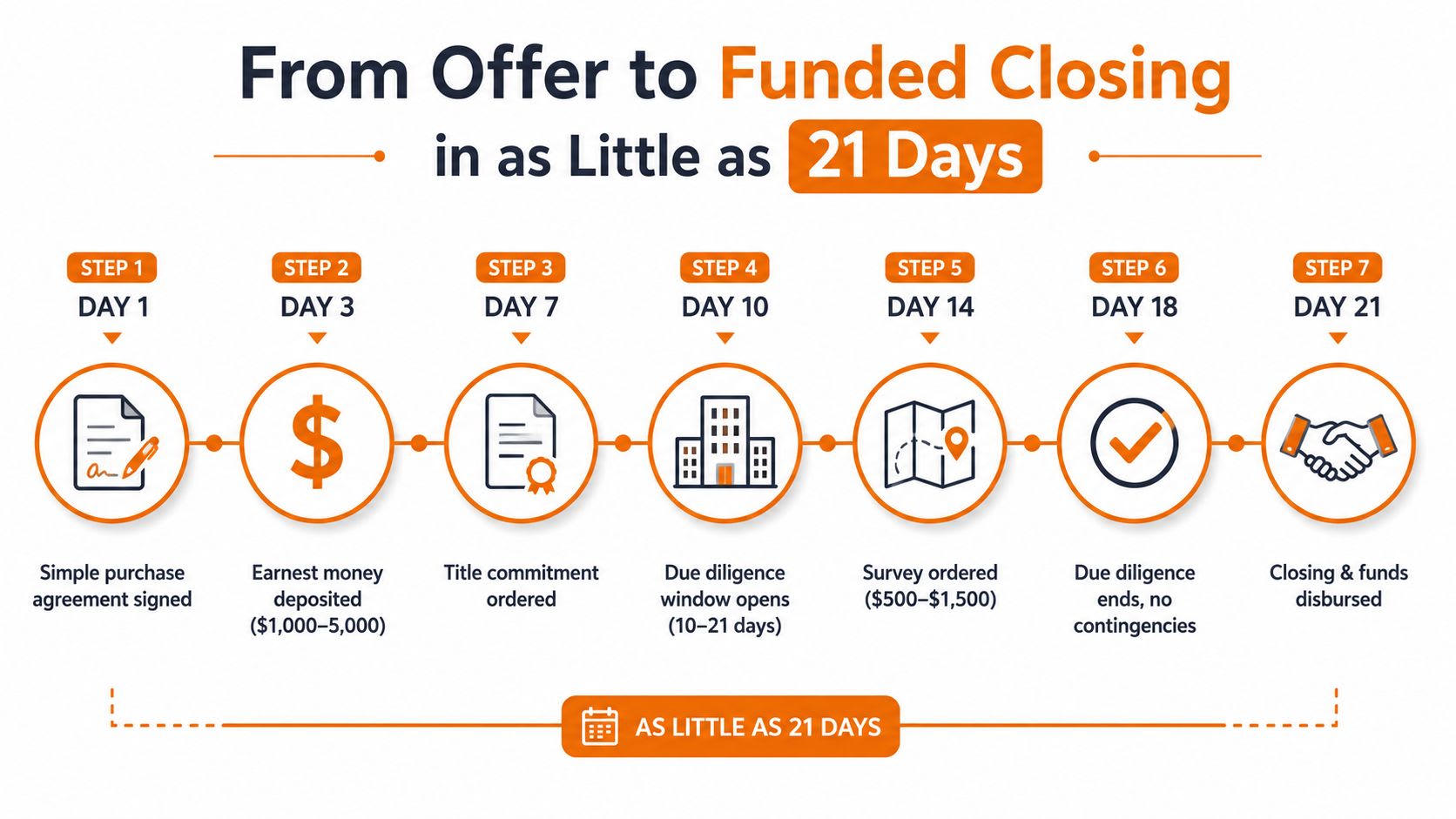
A clean inherited-land sale can move quickly once you choose a buyer, but speed does not cure an authority or title problem. The contract should remain subject to title clearance. Probate, missing heirs, liens, boundary defects, and recording requirements still need resolution. A defined closing window gives the title company and every signer a schedule for handling them.
The transaction roadmap
Day 1 begins with a written offer and purchase agreement. Read the legal description, purchase price, earnest-money terms, diligence rights, closing date, title conditions, and default provisions. Every heir or authorized representative must sign in the capacity required by the title company. A wrong signer or incomplete legal description can delay the transaction before the buyer begins meaningful review.
During early diligence, the buyer and title company verify ownership, access, taxes, liens, zoning, and property facts. Swift Land Buyers outlines a process for cash acquisitions. Review the closing section for the company's stated process and terms, and make sure every material condition appears in the agreement rather than remaining an informal promise.
If only part of the parcel is being sold, ask whether a survey-off structure fits the transaction. The survey and legal description must identify both the retained and transferred portions, along with access rights. Do not sign a partial-parcel agreement until the surveyor, title company, and buyer agree on the boundaries.
Documents that prevent avoidable delays
Prepare one digital folder containing:
- Death certificate: Obtain the version accepted by the title company and recorder.
- Estate documents: Include the will, trust certification, probate appointment, court orders, and heirship affidavits.
- Ownership records: Provide the prior deed, parcel number, legal description, and any surveys.
- Seller identification: Each signer needs valid identification and current contact information.
- Debt and tax records: Gather notices for property taxes, liens, mortgages, assessments, and association charges.
- Family approvals: Secure required co-owner signatures, spousal waivers, or buyout agreements.
The title company coordinates escrow, prepares or reviews closing documents, records the deed, pays approved liens, and distributes the remaining proceeds. Swift Land Buyers states that its transactions close through established title companies and that the title company generally wires funds promptly after signing. Actual funding depends on recording, lender payoff requirements, bank processing, and title clearance. Confirm the expected sequence with the closing agent instead of relying on a buyer's verbal estimate.
Quick decisions before signing
Ask yourself:
- Authority: Is probate, trust administration, survivorship documentation, or a beneficiary-deed transfer complete enough for the title company?
- Title: Have you received a current title commitment and understood every exception?
- Taxes: Do you have a defensible date-of-death appraisal and a CPA's view of the likely taxable gain?
- Family: Has every required owner and heir agreed to the sale or signed the necessary documents?
- Sale path: Does your choice reflect the actual priority, whether speed, certainty, maximum exposure, or minimum effort?
- Offer terms: Are the diligence period, closing costs, survey responsibilities, and funding conditions written clearly?
Some buyers may cover standard closing costs, accept a seller-selected closing date, offer an as-is transaction, or arrange a short post-closing leaseback where applicable. An advance may also be available in some transactions for travel or immediate expenses. Confirm the amount, repayment treatment, and effect on closing proceeds in writing. A convenience offered during the sale can become an unexpected deduction if the agreement does not explain it.
Questions heirs ask before selling
Can I sell land I've never visited?
Usually, yes, if you can establish ownership and legal authority, sign valid documents, and give the buyer accurate information. A site visit does not replace title work, a survey, access verification, or county records.
What happens if one heir refuses to sell?
You generally cannot convey that heir's interest without consent or a court remedy. Try a written buyout or mediation first. If that fails, ask a real-estate attorney about partition and the likely cost and timeline.
What if the land has a tax lien?
Tell the title company and buyer immediately. A lien may be paid from closing proceeds, but it can reduce the net amount, affect title insurability, and delay funding. Hiding it only gives the problem less time to be resolved.
Should I choose a cash offer just because it's fast?
No. Compare the cash offer with credible land comparables and the carrying costs of waiting. Speed has value, but decide what that value is before accepting a lower net result.
Collect the death certificate, estate documents, deed, and tax records now. Request a title commitment before marketing the parcel, then compare a cash buyer, MLS listing, and auction based on your family's priorities, title condition, and expected net proceeds.
Swift Land Buyers purchases vacant land and residential lots for cash, including inherited parcels, with as-is acquisitions and title-company closing. Visit Swift Land Buyers to submit the parcel details and discuss whether a direct sale fits your timeline, title situation, and net-proceeds goals.