
You might be sitting on a parcel that looks simple on paper, but isn't simple in practice. Maybe it's an inherited timber tract with three cousins on the deed, a vacant lot in a parish you moved away from years ago, or a rural piece that keeps collecting taxes while nobody has a development plan for it.
That's where cash buyers enter the picture, but the buyer matters as much as the offer. In Louisiana, the wrong buyer can get stuck on title, survey gaps, flood review, or heir property before closing ever gets funded.
What a Louisiana Cash Land Sale Actually Looks Like
A Louisiana seller usually is not searching for a buyer directory on a free afternoon. The trigger is more practical, a parcel inherited years ago, land that still carries taxes and upkeep, or a lot that no longer fits the owner's plans. I have seen the same sequence many times, a short call leads to an offer, then title work and due diligence decide whether the file keeps moving.
Cash deals do move faster than a traditional listing, but only if the buyer can handle the file. In Louisiana, a 7 to 14 day inspection window is a realistic pace for many cash buyers, and the full cash-to-close cycle often lands in 14 to 30 days when title is clean, while open-market land sales can stretch 12 to 24 months Reelvest's Louisiana land-sale timeline. If you want a buyer that explains how its review process works, Swift Land Buyers' land acquisition process lays out the kind of steps sellers should expect during that early inspection period.
What sellers feel during the process
The first stage is usually low-friction. The buyer asks for the parcel location, acreage, access, tax records, and whatever the seller knows about title history. After that comes the part that separates a real closing path from a marketing pitch, the title search, survey review, and a contract that has to survive the buyer's due diligence.
Practical rule: A fast offer only matters if the buyer keeps working after the first round of title questions.
If the tract has family ownership history, an out-of-state mailing address, or a tax issue attached to it, the buyer's closing posture matters more than the number on the first page. Some buyers can work through heirs, access issues, or a partial-interest problem. Others want only clean parcels with clear paper and back out as soon as the file gets complicated.
That is why this guide is not just a directory. It sorts buyers by how they behave when Louisiana land gets complicated, which is usually the point where a deal either closes or stalls.
Why Louisiana Attracts So Many Cash Buyers
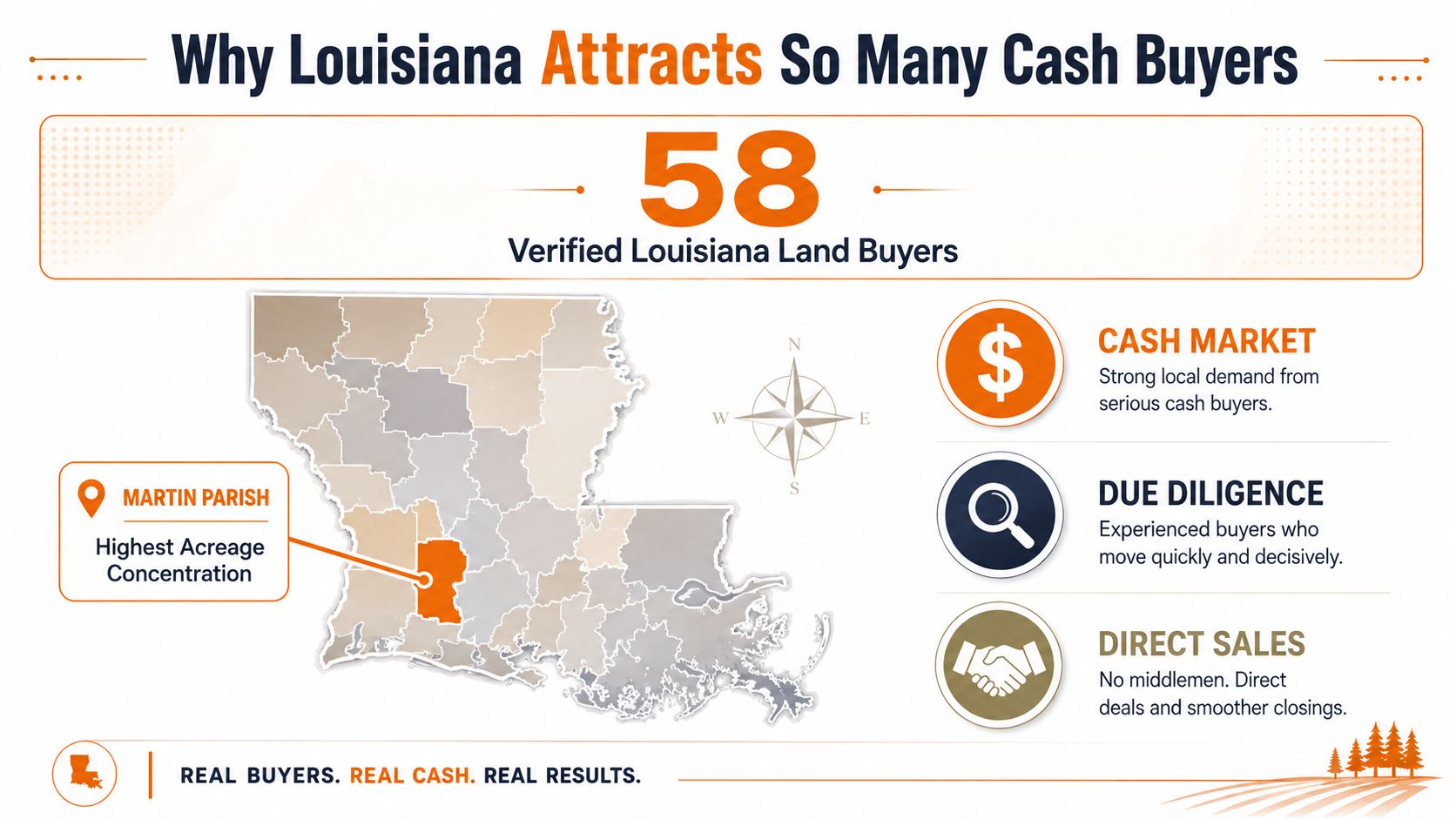
Louisiana is not a thin market with a handful of opportunistic flippers. One Louisiana directory lists 58 verified companies buying vacant land, raw acreage, timberland, farmland, and related property types across the state Louisiana land buyer directory. That points to a broad buyer base, and it helps explain why sellers can often find more than one cash path to closing.
Concentrated ownership creates room for capital
The acreage picture is a big part of the story. A Louisiana land market summary reports that the Martin family owns 582,000 acres of timberland, Bill and Melinda Gates own 70,000 acres, and Golden Ranch Farms spans 52,000 acres Louisiana land ownership summary. The same summary cites 1.39 million acres controlled by foreign investors, says Canadian companies hold 31% of that international base, and notes that the federal government owns over 1.33 million acres.
Those figures matter because Louisiana land deals often involve large blocks, long holds, and specialized uses. When a state has that kind of ownership concentration, buyers can justify the cost of title work, due diligence, and specialist underwriting. They also have to price in the extra time that comes with heir interests, older surveys, and mineral questions, which is why serious buyers in Louisiana usually keep a title team involved from the start.
Different buyer models fit different parcels
The directory also shows a mix of local cash investors, regional development groups, and firms that market nationwide acquisition models or focus on timber, farmland, and rural acreage Louisiana land buyer directory. That mix shows up across all 64 parishes in buyer marketing, so sellers are not limited to a few metro zones.
That variety matters in real transactions. A clean, buildable lot near growth can move quickly with one buyer type, while inherited acreage with access questions or a gap in the survey usually needs a buyer that is comfortable sorting through paperwork before closing. A buyer that handles one of those files well may stall on another, and Louisiana sellers feel that difference fast.
Louisiana attracts cash buyers because the state has enough rural complexity, acreage concentration, and ownership fragmentation to keep multiple buyer types busy. The market stays active, but that same complexity makes vetting more important, since the buyer who sounds strongest on the phone is not always the one who can close a parcel with title friction, flood-zone questions, mineral rights, or heir ownership.
The 10 Cash Land Buyers Operating in Louisiana
| Buyer Profile | Primary Parcel Focus | Typical Closing Posture |
|---|---|---|
| Nationwide land acquisition company | Vacant land, rural tracts, inherited parcels | Structured, title-driven, flexible on complexity |
| Local cash investor | Small lots, infill parcels, simple holdings | Fast on clean files, less tolerant of friction |
| Regional development group | Suburban land, infill acreage, buildable parcels | Wants clear access, survey, and exit potential |
| Timber-focused buyer | Forest tracts, managed timberland, larger acreage | Comfortable with rural scale and land-use nuance |
| Farmland specialist | Agricultural acreage, working land, legacy holdings | Evaluates use history and farm-related access |
| Assignment network | Deal flow from multiple investors | Can source a buyer, but closing control varies |
| Metro parish land buyer | Lots near growth corridors | Strong on location, limited on rural title issues |
| Rural acreage buyer | Remote, unimproved, hard-to-market parcels | More tolerant of distance and low liquidity |
| Infill-lot buyer | Smaller parcels in expanding parishes | Wants clean boundaries and buildability |
| Heir-property-capable buyer | Fragmented ownership, inherited tracts | Better suited to title cleanup and probate work |
1. Nationwide land acquisition company
A nationwide land company makes sense when the seller wants a remote, as-is sale and the file has a few wrinkles. These buyers usually know how to work through inherited parcels, absentee owners, and land that isn't ready for a standard retail listing. They're often the closest fit when the seller needs a process that is simple on the front end and disciplined on title.
2. Local cash investor
Local cash investors tend to move fast on simple lots, especially if the parcel is in or near a familiar parish and doesn't need much explanation. The trade-off is obvious, they're usually less patient with title issues, survey questions, or parcels that need a lot of back-end work. If the land is clean and the seller wants speed over complexity, this category can work well.
3. Regional development group
Regional developers care about what a parcel can become. They often like infill land, growth corridors, and properties with a clear path to future use, but they can get cautious if access, drainage, or survey data is weak. In Louisiana, that matters because a parcel can look fine on a map and still be hard to underwrite once the paperwork opens up.
4. Timber-focused buyer
Timber buyers are a different breed. They're usually more comfortable with larger acreage, rural tracts, and land where the value sits in the dirt, the trees, and the long-term holding profile. If a seller has a forest tract with management history or family ownership that's been in place for years, this category often understands the asset better than a generic lot buyer.
5. Farmland specialist
Farmland specialists want acreage that fits an agricultural use case. They tend to look beyond the raw parcel and consider access, use history, and whether the land supports a farm operation or can be positioned that way. Sellers with working land or former ag acreage usually get more traction here than with a development-only buyer.
6. Assignment network
Assignment networks can be useful when a seller needs speed but the first buyer isn't the final capital source. These groups route deals to vetted investors, which can help on less common parcels. The drawback is that control can get fuzzy, so sellers should be careful about who holds the file and who is responsible for the close.
Watch the paperwork chain. If the person making the offer isn't the same person controlling closing, ask who's responsible when title gets messy.
7. Metro parish land buyer
Metro parish buyers focus on lots near population growth and practical access. They're often strongest on simple, buildable parcels and weaker on raw timber or inherited rural tracts. If your land is close to expansion and the survey is clear, this type can be efficient.
8. Rural acreage buyer
Rural acreage buyers are built for distance, not convenience. They're often more tolerant of low-liquidity parcels, imperfect roads, and owners who don't live nearby. They're a better fit for sellers who need a buyer that understands a remote tract won't behave like a suburban lot.
9. Infill-lot buyer
Infill-lot buyers look for smaller parcels with a straightforward path to resale or construction. They usually want boundaries that are easy to verify and land use that doesn't require a lot of explanation. If the lot sits in a growing parish and doesn't have title complications, this category can move quickly.
10. Heir-property-capable buyer
Heir-property-capable buyers are the ones sellers should pay attention to when family ownership is fragmented. These buyers are more likely to tolerate missing signatures, probate questions, or a need to sort partial interests before closing. That doesn't mean they'll close on anything, but it does mean they're usually better equipped than a basic investor to handle inherited land.
A practical option in this category is Swift Land Buyers, which describes a direct land-purchase process with title-company coordination and an as-is approach for vacant land and lots.
The Four Due-Diligence Checks That Decide the Deal
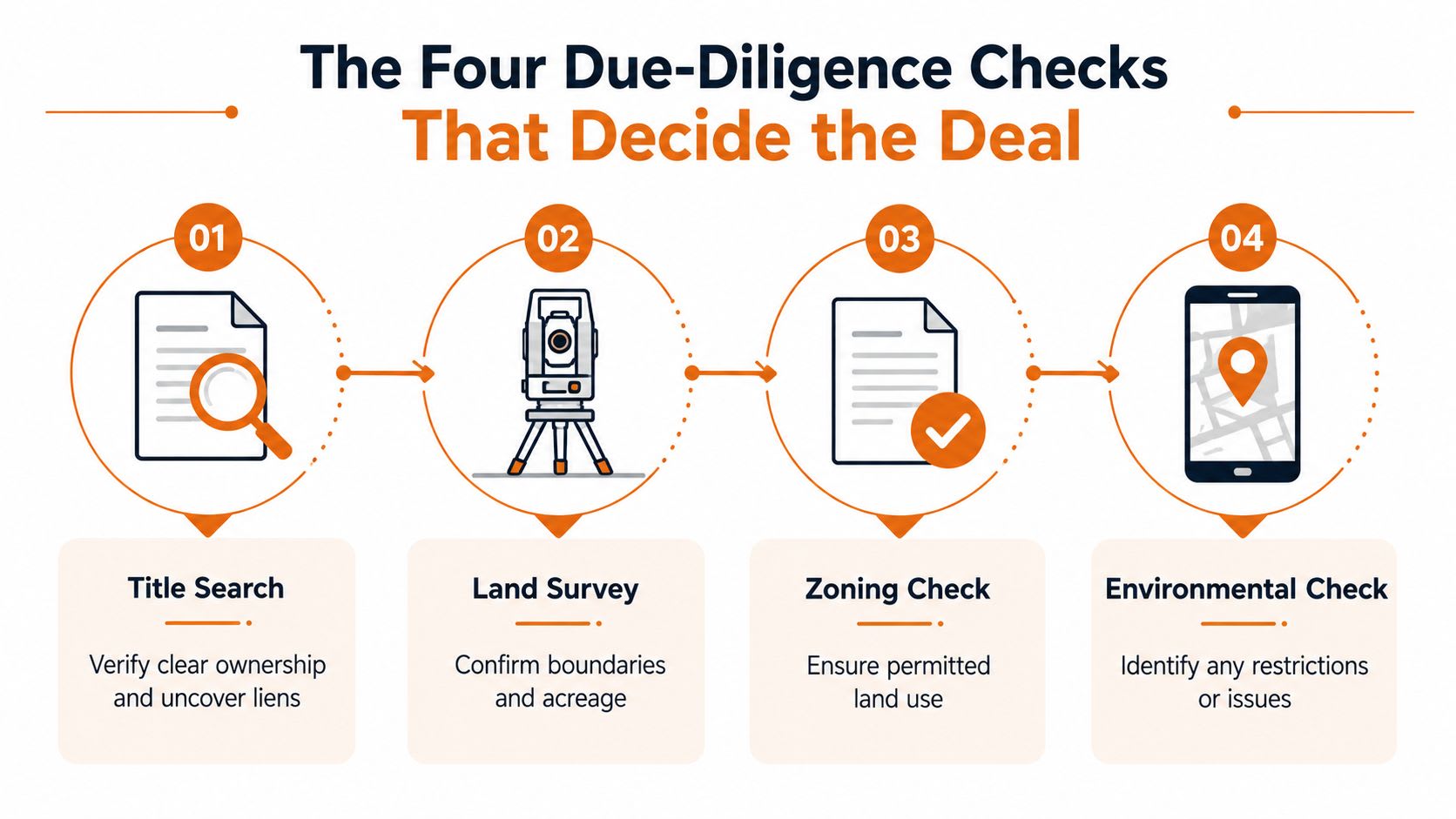
A cash offer can look solid and still die in title or survey review. Louisiana land buyers that close usually run four checks in order, not as a formality but as a gatekeeping system. The standard sequence is title, boundary, environmental or flood, then contract diligence before funds move Louisiana seller due-diligence guidance.
1. Title search
Title search is the first filter because ownership problems kill deals fast. A buyer needs to verify who owns the parcel, whether liens exist, and whether the deed history supports a clean transfer. Heir property, probate gaps, and old liens are common reasons a “cash” deal stretches beyond the target window.
2. Boundary survey or parcel verification
A survey isn't just paperwork, it tells the buyer what they're really buying. Missing surveys, mismatched acreage, or access conflicts can change the economics of a deal immediately. Inherited timber tracts are especially vulnerable here because family records often lag behind what the land physically looks like.
3. Environmental and flood review
In Louisiana, this check matters more than sellers sometimes expect. Flood-zone questions, drainage concerns, and site conditions can change a buyer's exit math, especially for land that might be used, developed, or held under a tighter margin. A buyer who understands Louisiana risk doesn't treat this step as optional.
4. Contract diligence
The contract has to match the file. That means the inspection window, title cure expectations, and closing responsibilities need to be written in a way that the buyer and seller can live with. If the agreement is loose, the deal can drift until everyone starts blaming the clock.
A buyer who rushes the signature and drags on title is not really offering speed. They're borrowing your time.
These four checks explain why some buyers close quickly and others stall. A good cash buyer doesn't just say they buy land as-is, they have a repeatable system for proving the parcel can transfer.
Matching Your Parcel to the Right Buyer Type
A Louisiana parcel rarely fits every buyer. A small infill lot in a growing parish and a 40-acre timber tract with family ownership issues demand very different underwriting.
The parcel-to-buyer match
- Inherited rural timber tract with unclear title: Best fit is usually a heir-property-capable buyer or a nationwide land acquisition company that's used to title cleanup. These buyers are more likely to stay engaged when probate, missing signatures, or old records slow the file.
- Small infill lot near growth: A regional development group or metro parish land buyer usually fits better. They're often focused on buildability, access, and exit potential rather than raw acreage.
- Large acreage with mineral-rights complexity: A timber-focused buyer or rural acreage buyer tends to be more realistic. These buyers are often more comfortable with long holding periods and land-use nuance than a retail-style investor.
- Tax-delinquent parcel facing pressure: A nationwide land company or local cash investor may move fastest if the file is otherwise readable. The more fragmented the ownership, the more important it becomes to confirm who can sign and who has authority.
What does not work is forcing every buyer into the same box. A developer may love a buildable lot and walk away from a timber tract. A timber buyer may care about acreage and ignore a tiny parcel. A local investor may be quick, but only on clean files.
The right question isn't “Who buys land for cash?” It's “Who buys this kind of land, with this kind of friction, on this kind of timeline?” That question saves a lot of wasted calls.
How to Vet a Cash Land Offer Before You Sign
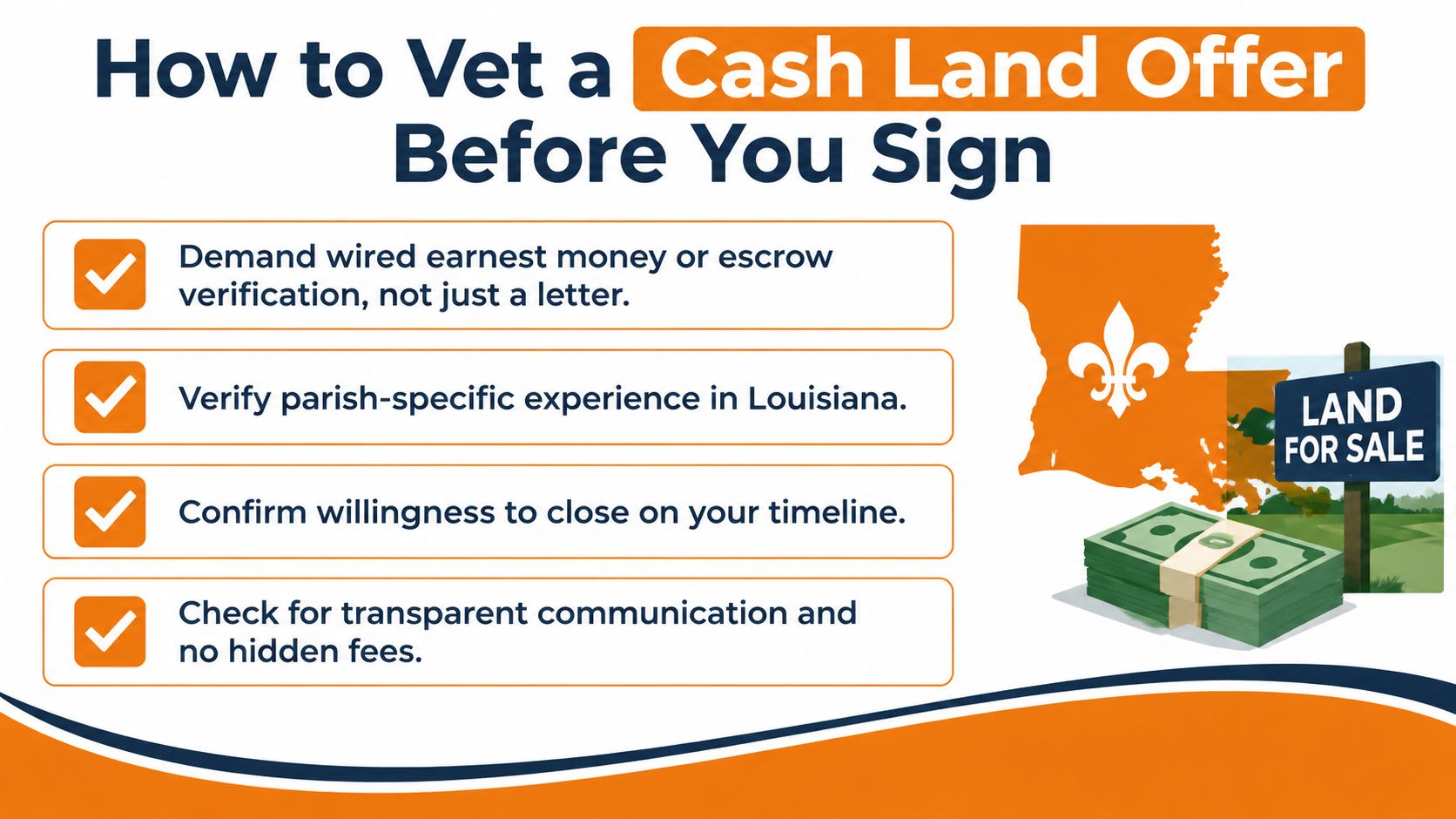
A cash offer can still fall apart if the buyer is thin on title experience, slow on follow-through, or vague about closing costs. In Louisiana, that risk shows up fast on inherited parcels, rural tracts with weak access, flood-prone land, and files that need more than a quick signature.
The first filter is simple. Ask for proof that the buyer can close, not just talk about closing.
Four checks that expose weak offers
- Demand wired earnest money or escrow verification, not just a letter. A proof-of-funds PDF is easy to forward. Real money in escrow shows the buyer is prepared to perform and that the file has made it past the marketing stage.
- Verify parish-specific experience in Louisiana. A buyer who understands one parish's title habits may still stumble in another if the land has rural access, old family conveyances, mineral-rights questions, or local record quirks. If you want a practical comparison point, review how a buyer handles rural files in another state, such as the process described in this California land buyer guide, then compare that approach with what they say they can handle in your parish.
- Confirm willingness to close on your timeline. Sellers often assume “cash” means flexible. It only is if the contract, title work, and underwriting pace can support the timing.
- Check for transparent communication and no hidden fees. If the buyer cannot explain who pays closing costs, what the title process looks like, and whether there are any side fees, keep looking.
The title company should be part of the vetting conversation too. Ask who is handling escrow, whether the closing will go through a licensed title company, and how long the inspection period really is. Buyers who work Louisiana land regularly can answer those questions without circling around them. Buyers who do not know the file often stay vague until the deal starts slipping.
Practical rule: If the buyer will not discuss title, survey, and closing costs in plain language, the offer is not ready.
A land offer should feel clear, not slippery. The more a buyer can explain the process without dodging, the more likely they are to close when Louisiana paperwork gets real.
A Realistic Timeline From Offer to Funded Closing
A Louisiana cash land sale has a clear sequence, but the pace depends on the file. It starts with the offer, moves into title review and document collection, then ends with escrow funding once the property record is clean enough for the title company to insure. Sellers should expect questions about parcel details, ownership history, access, and anything that helps the closing agent sort the record faster.
What happens in a normal close
The process usually begins with a call, text, or intake form. The buyer reviews the parcel, asks for supporting documents, and starts title work through a licensed title company. If title comes back clean, the deal can move from contract to funding without the long wait that comes with a retail listing.
Speed drops as soon as the file has friction. Probate holds, missing surveys, mineral-rights questions, flood-zone review, HOA concerns, and access problems all slow a closing. Buyers who handle rural Louisiana files every week usually stay engaged through those issues. Thin operators often act fast at the offer stage, then stall when the title company asks for real documentation.
That is why the earlier due-diligence checks matter. A buyer who understands title risk can tell you what is missing, who needs to sign, and what usually delays funding. A buyer who does not understand the file keeps promising a quick close, then blames the title company when the paperwork does not move.
What sellers should ask before agreeing to a close
- What starts the inspection window?
- Who orders title work?
- Who pays standard closing costs?
- What happens if a survey discrepancy shows up?
Those are practical questions, not small talk. They tell you whether the offer is ready to close or still depends on guesses about the title file.
The strongest buyers shorten the timeline by clearing uncertainty early. The weaker ones create uncertainty and call it flexibility.
If you want a practical sequence for selling land in Louisiana, the timing usually follows the same pattern described in Louisiana seller timeline guidance, offer, title review, document cure, then funding. The file moves quickly only when the buyer, seller, and title company can all answer the same questions without hesitation.
If the buyer will not talk plainly about title, survey, and closing costs, the offer is not ready. A land sale should feel clear from the start, because Louisiana paperwork gets slower, not faster, when people avoid the hard parts.
If you want a direct land sale path instead of a listing cycle, Swift Land Buyers works on vacant land and lots with title-company coordination and an as-is purchase process. Visit Swift Land Buyers to compare your parcel against a cash offer process that is built for inherited land, out-of-state ownership, and other Louisiana closing issues.